The Hidden Data Gaps in K-12: What You Can't Find (And Why)
The education data you wish existed, and why it doesn't. Understanding these gaps will save you hours of fruitless searching

After spending time with NCES databases and state DOE websites, you might assume that most of the information you need about school districts is publicly available somewhere. You just have to find it.
That assumption will waste a lot of your time.
The reality is that significant categories of information simply don't exist in any publicly accessible format. Understanding what data isn't available—and why—is just as valuable as knowing what is. It'll save you from rabbit holes, help you set realistic expectations with stakeholders, and point you toward alternative approaches.
Let's map the gaps.
---
Gap #1: Technology Inventory Data
What you want to know: What software, hardware, and EdTech products does this district currently use? What are they replacing? When do contracts expire?
What's actually available: Almost nothing.
Why This Gap Exists
There's no federal or state requirement for districts to report their technology purchases or inventory. Technology adoption is considered an operational decision, not a compliance matter.
Some states have started collecting basic information about device ratios (students per computer), but actual product-level data—what LMS are they using? what assessment platform? what intervention software?—isn't systematically collected anywhere.
What You'll Find Instead
Board meeting minutes: Some districts publish board minutes that include technology purchase approvals. These can reveal vendor names and contract values, but searching them is manual and inconsistent.
Technology plans: Districts receiving E-Rate funding must file technology plans. These sometimes mention current systems and future needs, but the level of detail varies enormously.
RFP postings: When districts go to bid, their RFPs sometimes reveal what they're replacing. But this only captures purchases above bid thresholds, and many EdTech purchases fall below those thresholds.
Press releases and news: Vendor announcements sometimes reveal customer wins, but coverage is sporadic and skewed toward larger districts and bigger deals.
Practical Workarounds
- Ask during discovery: "What are you currently using for [category]?" is a standard and accepted question
- Check vendor customer lists: Some EdTech companies publish customer logos or case studies
- Monitor RFPs: Services like RFPSchoolWatch aggregate education procurement postings
- Search board minutes: For high-priority targets, manually searching board meeting archives can surface technology decisions
- LinkedIn: Individual educators sometimes mention tools they use in posts or profiles
The technology inventory gap is perhaps the most frustrating for EdTech sales teams. You're essentially selling blind into what's already installed.
---
Gap #2: Contract and Procurement Data
What you want to know: What has this district purchased recently? From whom? For how much? When do contracts renew?
What's actually available: Fragmented and inconsistent.
Why This Gap Exists
Education procurement is governed at the state and local level, with wide variation in transparency requirements. While government procurement is theoretically public, the practical accessibility varies enormously:
- Some states have centralized procurement databases; others don't
- Some districts post all purchases online; others only post what's legally required
- Contract terms (especially renewal dates) are often not posted even when purchase records exist
What You'll Find Instead
State procurement portals: Some states (like Texas with ESBD or California with Cal eProcure) maintain searchable databases of public entity purchases. Coverage and detail vary.
GovSpend / SmartProcure data: Commercial services aggregate purchase order data from government entities. Coverage in K-12 is incomplete but growing.
Board meeting agendas: Large purchases typically require board approval. Board meeting records often include dollar amounts and vendor names, but searching across meetings is labor-intensive.
FOIA/public records requests: You can request procurement records from individual districts, but this is time-consuming and the response quality varies.
E-Rate filings: For telecommunications and internet services specifically, E-Rate applications and funding commitments are public record through USAC.
Practical Workarounds
- Ask during discovery: "When does your current contract come up for renewal?" is a legitimate sales question
- Monitor board meetings: For key accounts, following board agendas can surface upcoming technology decisions
- Use commercial databases: GovSpend and similar services can provide purchase history for covered districts
- Watch for RFPs: Bidding announcements often reveal contract cycles
The procurement data gap is slowly improving as transparency requirements expand, but comprehensive, real-time contract intelligence remains elusive.
---
Gap #3: Leadership and Contact Information
What you want to know: Who is the superintendent? Who leads curriculum? Who runs IT? What are their contact details?
What's actually available: Names sometimes, contact info rarely, and it's never complete or current.
Why This Gap Exists
NCES doesn't collect personnel data beyond aggregate counts. There's no federal requirement to report who holds which position, let alone their contact information.
District websites are the primary source, but:
- Website quality varies wildly (some are modern and complete; some are barely maintained)
- Staff directories are often incomplete or outdated
- Direct contact information (email, phone) is frequently not published
- Position titles aren't standardized across districts
What You'll Find Instead
District websites: The first place to check, but expect inconsistency. Large districts usually have staff directories. Small districts may only list the superintendent.
State DOE directories: Some states maintain directories of district superintendents, sometimes with contact info.
LinkedIn: Increasingly useful for identifying who holds roles and their background. Direct contact info isn't available, but InMail is an option.
Commercial databases: Services like ZoomInfo, Apollo, or education-specific databases attempt to compile contact information, with varying accuracy and freshness.
Conference attendee lists: Education conferences sometimes publish attendee lists or speaker bios that include contact info.
Practical Workarounds
- Start with the superintendent's office: Even if you can't find your target contact, the superintendent's assistant often knows who handles what
- Use LinkedIn strategically: Search for "[District Name]" + role title to identify individuals
- Call the main district number: Old-fashioned, but asking the receptionist "Who handles technology decisions?" works
- Check for department-specific pages: Curriculum, technology, and federal programs departments sometimes have their own web pages with staff listings
Contact data quality is a significant bottleneck for EdTech sales teams. It's why dedicated sales intelligence tools exist—and why even those tools struggle with education.
---
Gap #4: Student-Level and Classroom-Level Data
What you want to know: How do individual students or classrooms perform? What interventions have been tried? What's working?
What's actually available: Nothing, by design.
Why This Gap Exists
FERPA (Family Educational Rights and Privacy Act) protects student education records. Individually identifiable student data cannot be released without consent.
All publicly available education data is aggregated to protect student privacy:
- Proficiency rates are reported at the school or district level, not individual level
- Even subgroup data (by race, income, etc.) is suppressed when the group is small enough to potentially identify individuals
- Longitudinal tracking of individual student outcomes is not publicly available
This isn't a gap that can be closed through better data collection—it's an intentional privacy protection.
What You'll Find Instead
Aggregate proficiency data: Percentage of students at grade level, broken down by school, grade, and subgroup (where numbers are large enough)
Growth metrics: Some states report aggregate growth scores showing how much students improved, but still at the school or district level
Cohort data: Graduation rates, college enrollment rates, and similar metrics track cohort outcomes without identifying individuals
Practical Implications
- You cannot target individual students or classrooms
- You cannot obtain outcome data on specific students to demonstrate ROI without district cooperation
- Efficacy claims must be based on aggregate data or controlled studies
This gap is permanent and appropriate. Work within it by focusing on aggregate outcomes and partnering with districts on efficacy research where consent and proper data governance exist.
---
Gap #5: Real-Time or Current-Year Data
What you want to know: What's the enrollment RIGHT NOW? What's happening THIS school year?
What's actually available: Historical snapshots, typically 6 months to 3 years old.
Why This Gap Exists
Education data collection is built around annual reporting cycles:
- Enrollment is captured at "snapshot" dates (often October)
- Finances are reported after fiscal year close
- Assessment data is published after scoring and validation
- Each step in the reporting chain adds delay
Real-time data systems exist within districts and states, but they're not exposed publicly.
What You'll Find Instead
Fall enrollment snapshots: "Current" enrollment data usually means the prior fall's snapshot, already 6-12 months old by the time you see it.
Prior year finances: Financial data is always from a completed fiscal year, typically 2+ years ago.
State dashboards: Some states maintain dashboards with more current data than federal sources, but still not real-time.
Practical Workarounds
- Check district websites: Some districts publish current enrollment on their websites, sometimes as a simple count in their "About" section
- Ask during conversations: "What's your current enrollment?" is a normal discovery question
- Use state sources when available: State DOE data is often 6-12 months fresher than federal sources
- Monitor news: Local news often covers significant enrollment changes (growth, decline, new schools)
The real-time gap matters most for rapidly changing districts. For stable districts, last year's data is usually close enough.
---
Gap #6: Qualitative and Operational Data
What you want to know: What's the culture like? How do decisions get made? What are their pain points? What's the political environment?
What's actually available: You have to piece it together.
Why This Gap Exists
Quantitative data can be collected systematically. Qualitative context—culture, priorities, decision-making dynamics—can't be captured in a database.
What You'll Find Instead
Strategic plans: Published plans often reveal priorities, values, and challenges the district is trying to address.
Board meeting recordings: Many districts post video or audio of board meetings. Watching these gives you a feel for the political dynamics and current debates.
Local news coverage: Education reporters cover controversies, initiatives, and leadership changes that reveal context.
Superintendent messages: Many superintendents post regular communications that reveal priorities and tone.
Social media: District and administrator social accounts sometimes reveal culture and current focus.
Practical Workarounds
- Read the strategic plan: Usually linked from the district website, these documents are goldmines for understanding priorities
- Search local news: "[District name] schools" in Google News reveals recent context
- Watch a board meeting: Even 15 minutes can give you a sense of the district's dynamics
- Ask open-ended discovery questions: "What are your biggest priorities this year?" gets at context no database can provide
Qualitative intelligence often matters more than quantitative data for actually winning deals. The numbers get you in the door; the context helps you close.
---
Gap #7: Private and Charter School Details
What you want to know: Detailed enrollment, finances, and performance for private and charter schools.
What's actually available: Basic demographics only.
Why This Gap Exists
Private schools have no obligation to report to federal databases. The Private School Universe Survey (PSS) captures basic information (enrollment, affiliation, grade span), but participation is voluntary for financial data, and most don't participate.
Charter schools are included in CCD, but their unique governance structures (authorizers, CMOs) aren't well captured, and financial data can be complicated by their relationships with management organizations.
What You'll Find Instead
PSS basic data: Private school names, addresses, enrollment, religious affiliation
State charter data: Varies by state; some states have robust charter reporting, others minimal
Charter authorizer reports: Authorizers sometimes publish performance reports on their chartered schools
Form 990s: Nonprofit private schools and charter management organizations file 990s that reveal financial information (though interpreting them requires accounting knowledge)
Practical Implications
If you're selling to private or charter schools, expect more manual research and less standardized data than traditional public districts.
---
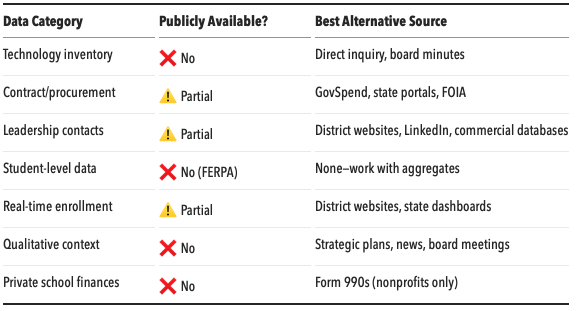
Mapping the Gaps: Summary
---
The Strategic Takeaway
The data gaps in K-12 aren't accidental. They reflect:
- Privacy priorities (FERPA protection of student data)
- Decentralized governance (no central authority requiring uniform reporting)
- Resource constraints (data collection costs money)
- Historical practice (reporting frameworks built before digital-first sales)
Rather than fighting these gaps, effective EdTech sales professionals:
- Use available data efficiently: Don't waste time searching for data that doesn't exist
- Build gaps into discovery: Ask the questions that public data can't answer
- Leverage qualitative sources: Strategic plans, news, and board meetings fill context gaps
- Invest in key accounts: For priority prospects, manual research (board minutes, FOIA, etc.) is worth the effort
- Accept uncertainty: Perfect information doesn't exist; make decisions with imperfect data
The hidden data gaps are a permanent feature of K-12 sales intelligence. Understanding them is the first step to working effectively despite them.