Title I 101: What Federal Funding Status Actually Means for EdTech Sales
The metric every EdTech sales rep references but few truly understand, and why "low-income" doesn't mean "low budget."

If you've spent more than a week selling to K-12 schools, you've heard the term "Title I." It shows up in district profiles, gets mentioned in discovery calls, and often shapes how reps prioritize their territories.
But here's the problem: most EdTech sales professionals fundamentally misunderstand what Title I means, and that misunderstanding costs them deals.
The most common mistake? Assuming Title I schools have less money to spend. In reality, the opposite is often true.
Let's fix that.
What Is Title I, Exactly?
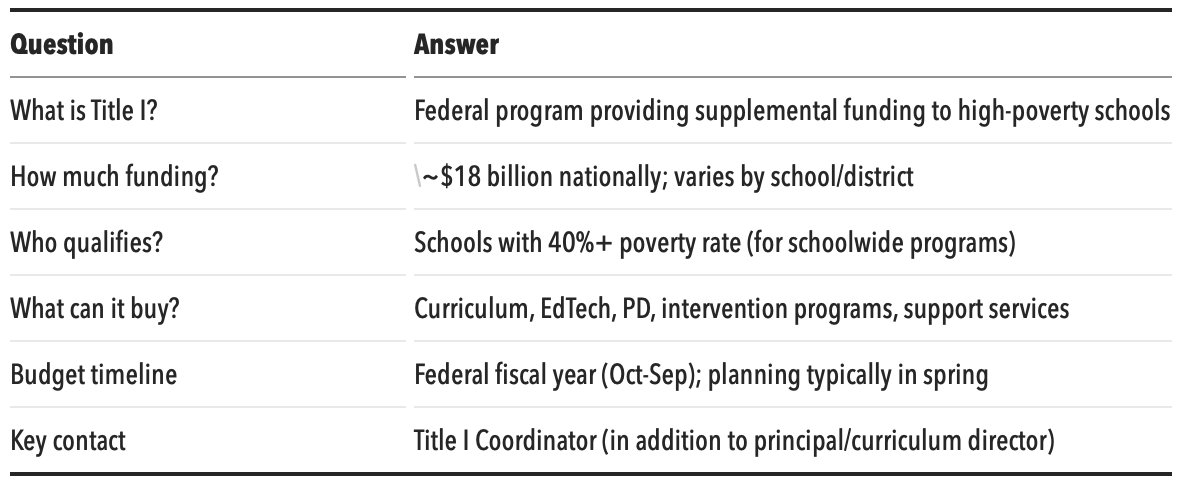
Title I refers to Title I, Part A of the Elementary and Secondary Education Act (ESEA), the largest federal education program in the United States. It provides supplemental funding to schools and districts with high percentages of students from low-income families.
The numbers are significant:
- $18.4 billion in annual federal appropriations (FY 2024)
- More than 50,000 schools receive Title I funds
- Over 25 million students are served by Title I programs
Title I isn't a designation that means "poor school." It's a funding stream that provides additional resources on top of state and local budgets.
This distinction matters enormously for sales.
How Schools Qualify for Title I
Schools qualify for Title I funding based on the percentage of students from low-income families, typically measured through Free and Reduced-Price Lunch (FRPL) eligibility.
The threshold varies, but generally:
- Schools with 40% or higher poverty rates can operate "schoolwide programs" (most flexible use of funds)
- Schools with 35-39% poverty rates may qualify for "targeted assistance programs" (funds restricted to specific students)
- Districts receive allocations based on census poverty data and per-pupil funding formulas
There's an important nuance here: the Community Eligibility Provision (CEP) allows high-poverty schools to provide free meals to all students without individual applications. This means FRPL percentages in CEP schools don't reflect actual poverty rates—they show 100% even when the underlying poverty rate might be 60-70%.
When you see a school with 100% FRPL, don't assume every family is below the poverty line. It often means the school qualified for CEP, which requires at least 40% of students to be "directly certified" for free meals through other programs like SNAP or TANF.
Why Title I Schools Often Have MORE Budget, Not Less
Here's where the conventional wisdom falls apart.
Title I schools receive their regular state and local funding plus supplemental federal dollars. A Title I elementary school might receive an additional $500-$2,000 per eligible student annually, depending on the district's allocation formula and the school's poverty concentration.
Consider two hypothetical elementary schools in the same state:
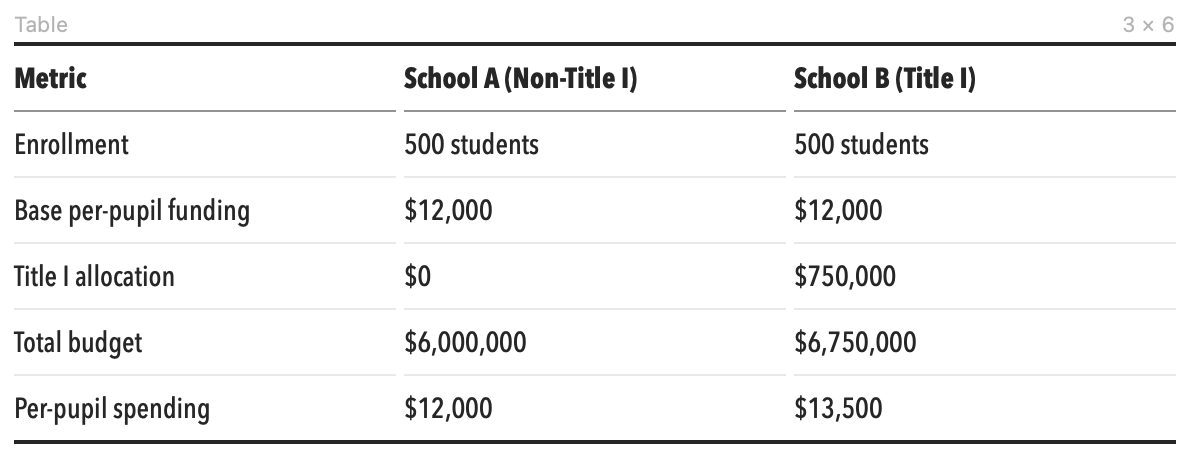
School B has 12.5% more to spend per student—and much of that Title I money is specifically earmarked for instructional improvement, intervention programs, and educational technology.
Title I funds can be used for:
- Instructional materials and curriculum
- Educational technology and software
- Professional development
- Extended learning time programs
- Parent and family engagement
- Support services for at-risk students
Sound like your product categories? They should.
The Title I Buying Cycle
Title I funding follows the federal fiscal year (October 1 - September 30), but districts typically plan their Title I spending during spring budget season (February-May) for implementation the following school year.
Key timing considerations:
- January-February: Districts analyze student performance data and identify needs
- March-April: Title I budgets are drafted and programs are selected
- May-June: Final allocations confirmed, purchasing decisions made
- July-August: Implementation and onboarding for fall
- September-December: Programs in operation, mid-year adjustments possible
Many districts also have "use it or lose it" pressure with federal funds. Unspent Title I allocations can create end-of-year purchasing windows, particularly in June and September.
Pro tip: Ask about carryover funds. Districts can carry over up to 15% of their Title I allocation to the following year, but money beyond that threshold gets redistributed. If a district is sitting on carryover funds approaching the limit, they have strong incentive to spend before the fiscal year ends.
What Title I Status Tells You About a District
Beyond the funding implications, Title I status signals several things about a district's priorities and challenges:
- Accountability Pressure: Title I schools face additional federal accountability requirements. They must demonstrate adequate yearly progress and can face escalating interventions if they consistently underperform. This creates urgency around improvement—and budget for solutions that can demonstrate impact
- Data Infrastructure: Title I compliance requires detailed tracking of student outcomes, subgroup performance, and program effectiveness. Title I schools often have more robust data systems and greater familiarity with evidence-based interventions.
- Decision-Making Complexity: Title I funds come with strings attached. Purchases must be "reasonable and necessary" for the program's goals, documented appropriately, and often reviewed by federal program monitors. Your champion may need to justify the purchase to a Title I coordinator, not just a principal.
- Focus on Struggling Students: By definition, Title I programs target students who are behind academically. If your product addresses intervention, remediation, differentiated instruction, or closing achievement gaps, Title I schools are your bullseye.
Conversation Starters for Title I Districts
Armed with this context, you can have much more sophisticated conversations with Title I schools. Here are specific angles to explore:
For discovery calls:
- "How are you currently allocating your Title I funds across intervention and technology?"
- "What's your timeline for Title I budget planning this year?"
- "Are you seeing any carryover funds that need to be allocated before September?"
For demonstrating fit:
- "Our platform is specifically designed to support the intervention goals that Title I programs prioritize."
- "Many of our Title I customers use our reporting to satisfy their evidence-based intervention requirements."
- "The per-student cost fits well within typical Title I per-pupil allocations."
For navigating procurement:
- "Who's your Title I coordinator? We should make sure they're comfortable with how this aligns with your program plan."
- "We can provide the documentation you'll need for Title I compliance—allowability memos, evidence of effectiveness, and outcome tracking."
Red Flags and Considerations
Title I isn't a universal green light. Watch for these situations:
Funding instability: Federal education funding is subject to political cycles. While Title I has been stable historically, districts may be cautious about committing to multi-year contracts funded by federal dollars.
Restrictive use requirements: Some Title I coordinators interpret allowable uses narrowly. If your product is adjacent to but not directly instructional, you may face pushback.
Supplement vs. supplant: Title I funds must supplement, not replace, state and local funding. If the district was already providing a similar solution with local funds, they can't simply shift that cost to Title I. Your product needs to represent an enhancement, not a substitution.
Audit sensitivity: Districts that have faced Title I audits or monitoring findings may be extra cautious about new purchases. This isn't a disqualifier, but expect a longer procurement process with more documentation requirements.
The Bottom Line
Title I status should move a district up your priority list, not down. These schools have:
- Additional funding specifically for instructional improvement
- Accountability pressure that creates urgency
- Clear needs around intervention and achievement gaps
- Established processes for evaluating and purchasing educational solutions
The next time you see a high Title I percentage in a district profile, don't skip past it. Lean in. That federal funding might be exactly what makes the deal possible.
Quick Reference: Title I Facts for Sales